
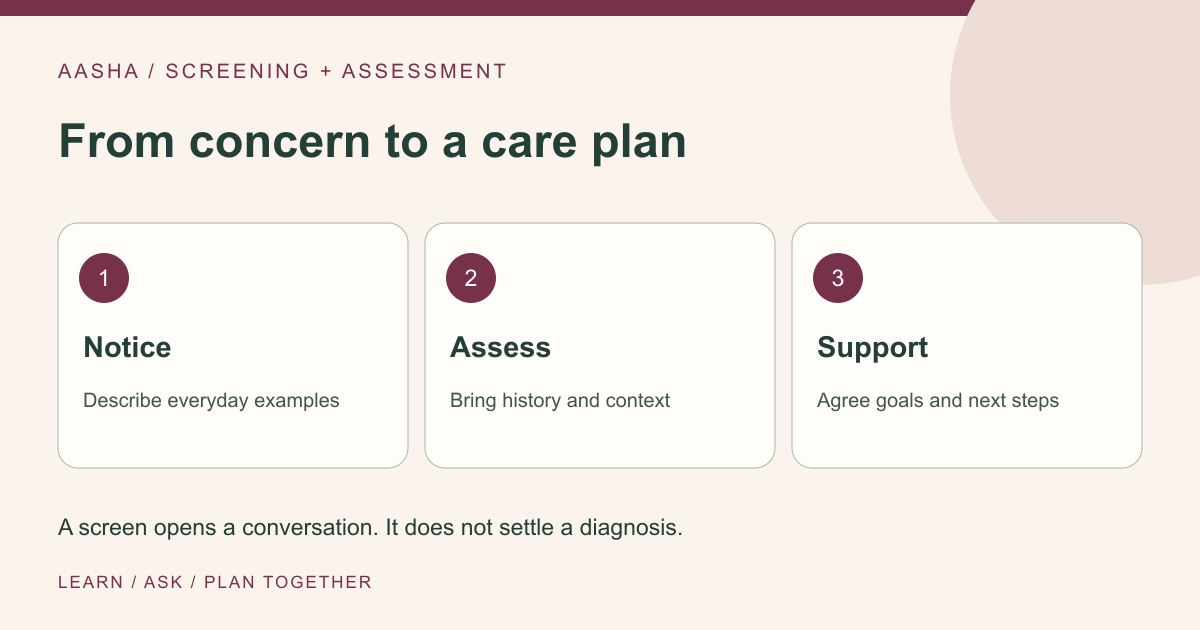
Four stages that are often confused
Developmental monitoring means noticing how a child communicates, plays, moves, learns and manages everyday activities over time. Screening uses a structured method to identify children who may need further evaluation. Diagnostic assessment investigates whether a pattern meets criteria for a condition. Support planning asks what will help the child participate now.
These stages are connected, but one does not do the job of all the others. A milestone checklist cannot establish a diagnosis. A diagnosis does not automatically specify the right number of therapy sessions. A child can also have a meaningful language, learning or sensory need without receiving the diagnosis a family first suspected. The assessment should help explain that outcome rather than simply issue a yes-or-no result.
Swipe or scroll the table to read all columns.
| Stage | Main question | Useful result |
|---|---|---|
| Monitoring | What is changing in everyday development? | Specific observations over time |
| Screening | Is a closer look indicated? | Follow-up or referral guidance |
| Assessment | How do the concerns fit the developmental and medical picture? | An explanation of findings and remaining uncertainty |
| Planning | What support would make daily life easier? | Goals, responsibilities and a review date |
When to raise a concern
Do not wait for a child to match every item on an internet list. Difficulties with communication, play, social interaction or everyday functioning can be discussed at a routine health visit. The AAP schedule described by CDC includes autism screening at 18 and 24 months, but that schedule is not a reason to postpone an earlier concern or dismiss one raised later.
Loss of a previously established skill is a different concern from learning a skill later than peers. If a child stops using words, gestures or movement skills they previously used consistently, describe that change promptly to a medical professional. Sudden illness, seizures or marked changes in awareness require medical attention rather than waiting for a developmental screening appointment.
Source: CDC: clinical screening for autism.
Understanding M-CHAT-R/F without overreading the score
The Modified Checklist for Autism in Toddlers, Revised with Follow-Up is designed for toddlers aged 16–30 months. The follow-up component matters: it clarifies responses that may have been misunderstood or may reflect a different developmental concern. Use the official instructions and appropriate language version rather than an altered social-media quiz.
A result indicating increased likelihood means further evaluation is appropriate; it does not tell a parent that their child definitely has autism. A reassuring result is also not a lifetime clearance. Screening is a snapshot, and persistent concerns still deserve discussion. This website links to the tool owner rather than reproducing a questionnaire, changing its wording or presenting a local score as an independent diagnosis.
Source: M-CHAT-R/F: official screening tool and permissions.
What the assessment conversation may explore
The clinician may ask about pregnancy and birth, early development, communication, play, routines, sensory experiences, sleep, eating, health and family history. These questions are intended to understand the child, not to assign blame. A history of caesarean birth, formula feeding or an illness does not by itself explain why a child is autistic.
Assessment may involve observation and standardized tools, alongside information from caregivers and education settings. Hearing, language, learning and other health questions may need their own evaluation. Tools differ in purpose: an autism screening instrument, a diagnostic observation and a functional or disability assessment are not interchangeable. Ask which question each proposed tool addresses and how its result will be interpreted in your child’s context.
Preparing useful examples in a multilingual family
Describe all the languages a child hears and uses, with whom they use them, and whether the concern appears in each language. Bring examples of gestures, expressions, understanding and communication beyond spoken words. If a child communicates comfortably with a grandparent but says little in school, explain the setting rather than reducing the difference to a single vocabulary count.
Useful examples are brief and ordinary: how the child asks for help, shares an interest, responds when a favourite activity ends or joins familiar play. Record what the adult did as well. You do not need to repeatedly prompt eye contact, remove favourite objects or create distress to “show the problem”. Ask permission before sharing recordings and keep a child’s videos out of public groups.
Making sense of the report
A helpful report should explain the information considered, the findings, what remains uncertain and the recommended next steps. Ask for unfamiliar terms to be translated into everyday examples. A score may compare performance with a reference group, but it should not be treated as a prediction of everything a child will or will not achieve.
Before leaving, clarify who is responsible for each referral and when results will be reviewed. Ask whether recommendations are essential now, useful later or conditional on another finding. For families in India, a clinical diagnosis, school support discussion and formal disability certification may involve different processes. Confirm current requirements with the relevant service instead of assuming that one report automatically completes all three.
Starting support while questions remain
Families can discuss practical communication support, predictable routines and school adjustments while assessment continues. The plan should match the difficulty observed. A visual choice board addresses a different need from a quieter classroom place or a hearing evaluation. It is reasonable to ask why a particular intervention is being suggested and what benefit would look like.
Keep the first plan manageable. Select one or two priorities, agree how the adults involved will help, and set a time to review. At Aasha, the appointment planner and developmental check-in can help organize your questions before discussing assessment. Their purpose is preparation: they do not replace validated tools, diagnose autism or require families to complete every field before seeking care.