
What counts as a loss of skills?
Regression means a reduction or loss in an ability that was previously established. Examples might involve language, gestures, social interaction, walking, hand use or everyday self-care. The important detail is that the child had used the skill consistently, rather than performing it once under unusual circumstances.
A developmental plateau means progress has slowed or stopped without a clear loss. A situational difference means a child can still use a skill in some settings but not others. All three can warrant attention, but they suggest different questions. A child who speaks at home but becomes silent in a new classroom needs a different description from a child who has stopped using previously frequent words everywhere.
Swipe or scroll the table to read all columns.
| Pattern | Example | Question to clarify |
|---|---|---|
| Possible regression | Previously frequent words are no longer used anywhere | When were they last used consistently? |
| Plateau | Existing words remain, but new communication is not developing | What has changed in demands or development? |
| Context-dependent difficulty | Communication changes between home and school | Which setting, language or support makes a difference? |
Decide whether the situation is an emergency
A child who is difficult to wake, has breathing difficulty, develops sudden weakness or cannot move normally, or has a prolonged seizure needs emergency medical care. Do not wait to complete a diary, obtain a developmental appointment or try a dietary change. If a seizure is occurring, protect the child from nearby hazards and seek urgent help; do not place anything in the mouth.
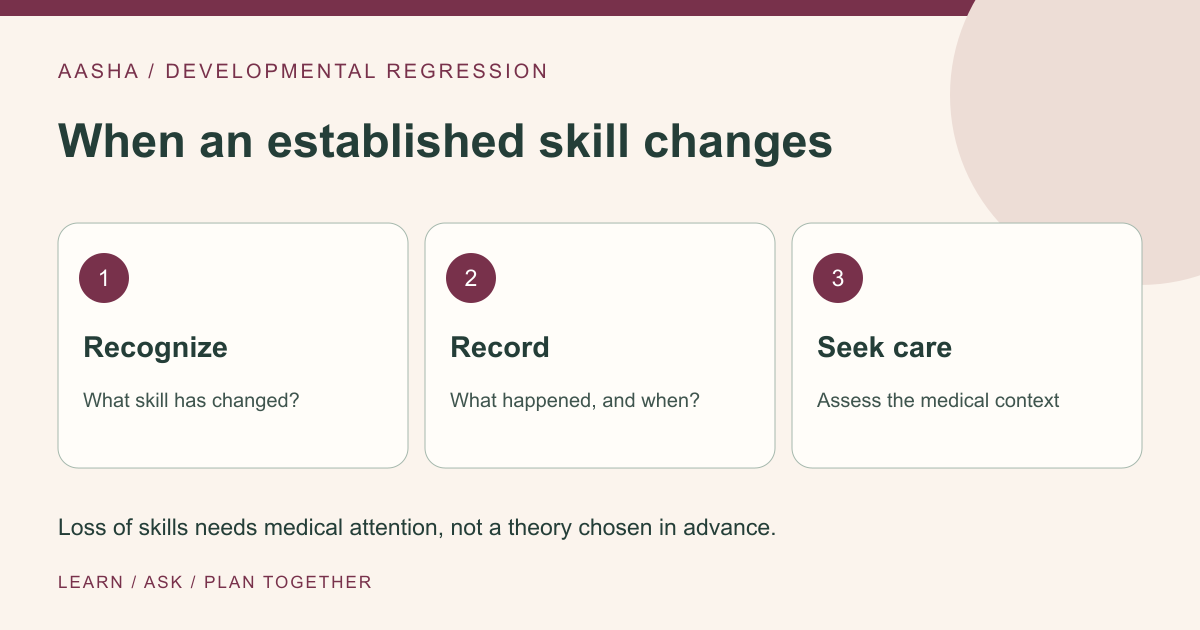
For a child who is otherwise stable but has lost previously acquired skills, contact a paediatric clinician promptly and explicitly use the phrase “loss of skills”. Explain the pace of the change and any associated illness, unusual movements, episodes of reduced awareness or change in walking. A routine question about speech delay may be triaged differently from a report of actual language loss.
Build a short, factual timeline
Start with the last period when the skill was reliably present. Note the first change you noticed, whether it happened suddenly or gradually, and whether other people observed it. Include sleep, appetite, fever, medicine changes, pain and major changes in environment. Do not omit an event because it seems unrelated, but do not assign it a cause-and-effect relationship either.
Use existing messages, school notes or familiar videos to support recall if they are readily available. There is no need to reconstruct every day of the child’s life. When dates are uncertain, say “approximately two weeks” rather than inventing precision. Bring a current medicine and supplement list: the product name and formulation are more useful than “a tonic”.
What a clinician may need to distinguish
The assessment considers development alongside neurological and general health. Hearing changes, seizure-related concerns, pain, sleep disruption and other medical or developmental explanations may need attention. The clinician uses the age, type of skill loss, examination and associated features to choose the next step.
NICE distinguishes referral decisions involving language or social regression from those involving motor regression and older children. The practical message for a family is that the pattern matters: tell the clinician exactly which skills changed. Autism assessment may be part of the pathway, but it does not replace medical evaluation of new neurological symptoms. Not every child needs the same scans, blood tests or genetic investigations.
Why regression does not prove mitochondrial disease
The supplied teaching notes repeatedly connect regression after illness with mitochondrial dysfunction. Illness can be relevant in the history of a child with a metabolic disorder, but it is not a specific diagnostic signature. Many children have infections, sleep disruption or reduced activity around the time a concern becomes noticeable.
A specialist may consider metabolic or genetic investigation when the broader pattern supports it. An isolated symptom or a commercial panel cannot substitute for that judgement. Likewise, a normal initial test does not resolve every possible cause. Ask what condition is being investigated, why the proposed test is useful and what the next step would be for either result. Avoid treating a supplement response as confirmation of a rare disease.
Understanding events that happen close together
When a worrying change follows a memorable event, it is natural to connect them. A temporal association is worth recording, but it does not establish causation. The child’s age, other changes occurring at the same time and the expected background frequency of events all matter.
The notes also mention vaccination in this context. WHO’s December 2025 review found no causal link between vaccines and autism. That evidence should not be replaced by an inference from a single timeline. A family can report a health event, seek assessment of the child and discuss vaccination questions without assuming that the event explains an autism diagnosis.
Support the child while the assessment proceeds
Keep communication accessible and daily routines as understandable as possible. Offer familiar ways to request help or comfort, including gestures or pictures if these are already useful. Avoid repeatedly testing a missing skill throughout the day: this can add pressure without giving the clinician a clearer history.
Ask the care team what changes should trigger urgent reassessment, which appointments are being arranged and who will follow up results. If an intervention has been proposed, ask for its specific indication and review plan. New pain, rashes, marked agitation or worsening function should not be dismissed as “detox”. The priority is the child’s health and comfort, not completing an experimental protocol. Use the appointment planner to keep outstanding questions together.