
Methylation: what the word actually means
Methylation is the transfer of a small chemical unit called a methyl group. Different methylation reactions help cells regulate molecules and biological processes. DNA methylation is one aspect of gene regulation; it is not a simple switch that turns “autism genes” on or off. Different tissues and different sites on DNA can behave differently.
The folate and methionine cycles help supply the chemical materials used in these reactions. Folate is a B vitamin involved in one-carbon metabolism. Methionine can be converted into S-adenosylmethionine, usually shortened to SAMe, which donates methyl groups. After donation, further reactions lead to homocysteine. Homocysteine can be recycled toward methionine or directed through other pathways. These names describe normal metabolism, not an autism subtype.
A useful map of the terminology
The teaching notes connect the folate cycle, methionine cycle and transsulfuration pathway. That is useful as a biochemical map, provided it is not mistaken for a diagnostic chart. In a living person these pathways interact with nutrition, enzymes, illness and many regulatory processes; a symptom cannot reveal the concentration of every intermediate.
A good explanation should specify which measurement is actually available, what that measurement reflects and what it does not. A diagram with arrows is a model of reactions. It is not a scan showing that a particular child has a blocked arrow.
Swipe or scroll the table to read all columns.
| Term | Plain-language meaning | Important limit |
|---|---|---|
| MTHFR | An enzyme involved in producing a form of folate used in metabolism | A common variant does not by itself diagnose a developmental condition. |
| Homocysteine | An intermediate in methionine metabolism | An abnormal result needs clinical context, not an automatic supplement stack. |
| SAMe | A molecule that supplies methyl groups for many reactions | Its role in a pathway does not establish benefit from supplementation. |
| Glutathione | A molecule involved in cellular antioxidant defence | A research finding about oxidative stress is not a universal treatment indication. |
Common variants versus rare genetic disease
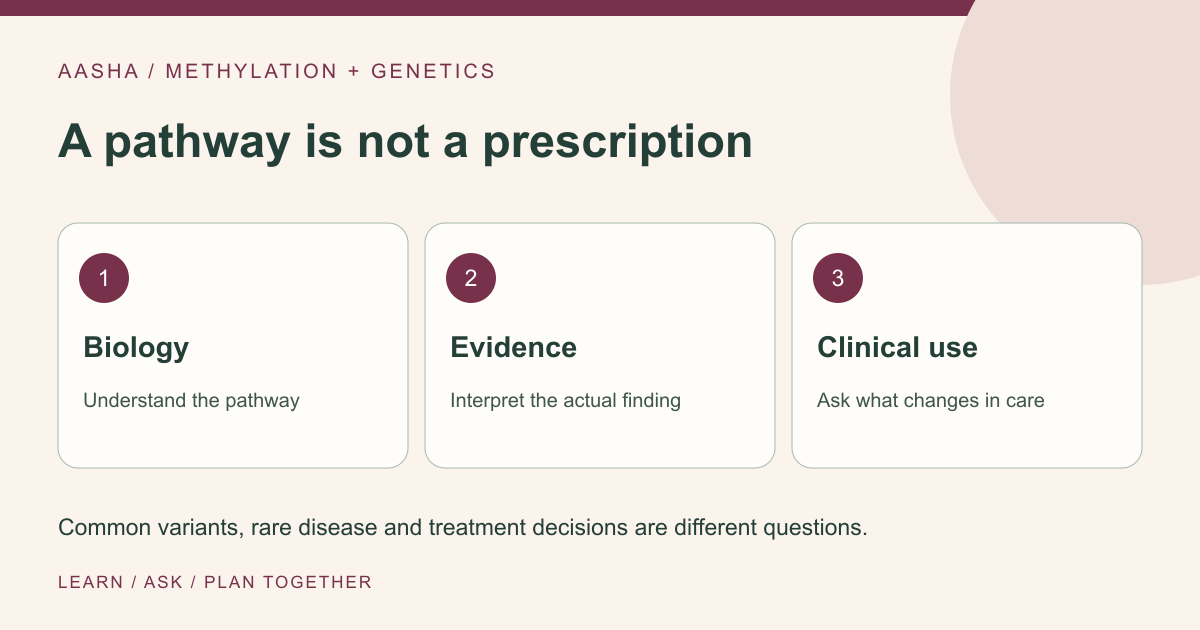
MTHFR C677T and A1298C are commonly discussed variants. Some variants can alter enzyme activity; their clinical importance depends on the variant and the wider context. Rare MTHFR-related metabolic disease is a different situation from finding a common polymorphism on a consumer report.
The distinction matters because the phrase “MTHFR mutation” is often used without qualification. Ask for the exact variant, the laboratory’s classification and whether the finding explains the clinical presentation. A report may identify a variant without establishing that it caused a child’s symptoms. Genetics professionals can help interpret uncertain or complex results, including whether further investigation is appropriate.
Source: MedlinePlus Genetics: MTHFR.
Why “overmethylated” and “undermethylated” charts overreach
Charts in the supplied material assign rigidity, anxiety, sleep difficulty or sensory sensitivity to opposing methylation categories. Those experiences are not specific biochemical measurements. The same child can have several of them for reasons involving communication demands, sleep, pain, attention, anxiety or the environment.
Nor can a reaction to a multivitamin establish a methylation diagnosis. The product may contain multiple ingredients, and timing alone does not identify the cause of a change. Record the reaction and discuss the actual formulation with a clinician. A treatment algorithm that moves directly from “red ears” or “rigid behaviour” to a biochemical label skips the work needed to establish what is happening.
COMT and MAO-A do not provide a personality prescription
COMT and MAO-A are involved in metabolism of signalling molecules. It is tempting to turn this into a simple story: a “slow” enzyme means a particular neurotransmitter is high, therefore a child must need or avoid a particular supplement. That story leaves out tissue differences, other enzymes, regulation and the complexity of a developing nervous system.
A common variant in one gene does not give a direct reading of brain dopamine or serotonin. It also does not replace standard prescribing assessment. If a report claims to predict which product will calm a child, ask for evidence that the specific test-guided strategy improves meaningful outcomes compared with ordinary clinical care. Evidence that a variant changes an enzyme in a laboratory is a different question.
What to ask before ordering tests
Start with the clinical question. Is a clinician investigating an actual nutritional deficiency, an unexplained metabolic abnormality, a family history or a broader genetic cause of developmental difficulties? The question should determine the test. A large panel is not necessarily better than a focused investigation.
Ask how results will be explained, including a normal finding or a variant of uncertain significance. Confirm the full cost of interpretation and follow-up, not only the collection fee. Consider privacy too: genetic information can have implications for relatives, and a downloadable consumer report may contain more information than a school or therapy provider needs. Keep the decision connected to the child’s care rather than to the number of coloured flags in a report.
Nutrition and medicines: a more useful conversation
A clinician can investigate a suspected deficiency and recommend treatment for it without adopting an unvalidated methylation category. Bring a list of foods regularly accepted, relevant symptoms, prescribed medicines and every supplement. Include labels: separate products often contain overlapping ingredients.
“Natural” and “vitamin” do not mean unlimited amounts are safe. Avoid adding methylfolate, methyl-B12, niacin, SAMe or combinations based on a chart. If a product is prescribed, ask what the target is, how benefit will be judged and when it will be reviewed. Folinic acid and rare folate transport disorders deserve a separate discussion; they are not interchangeable with a common MTHFR result or a general claim that a child needs methylation support.