
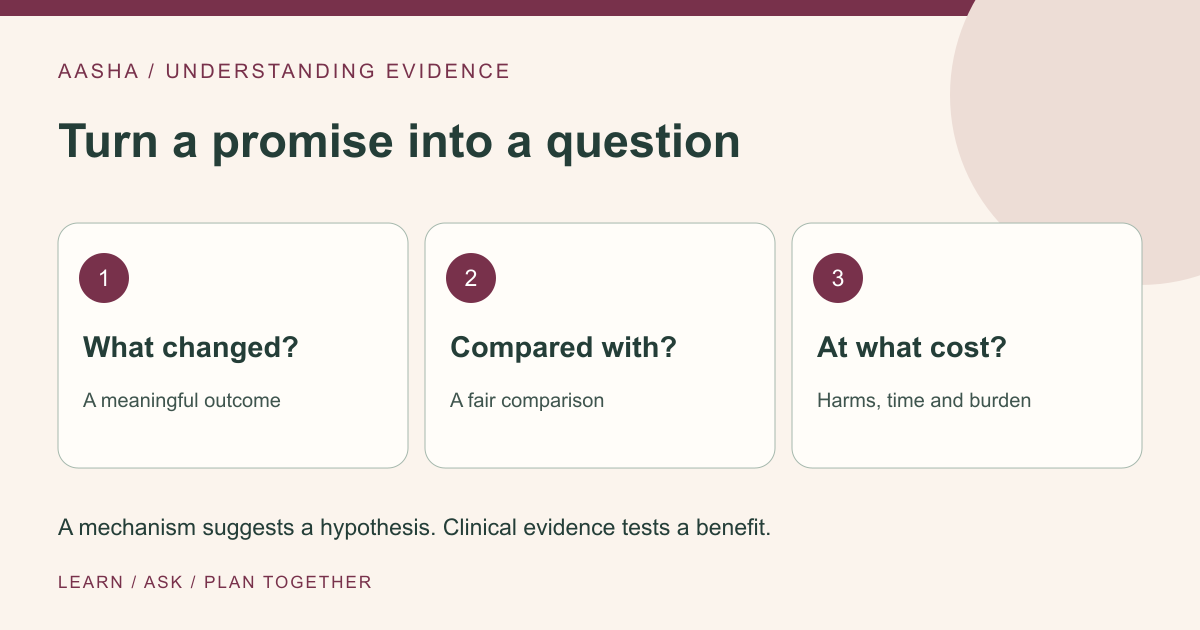
Translate the promise into a question that can be tested
“Improves brain health” is too vague to evaluate. Ask which intervention, for which children, compared with what, over what period, and measured how. A programme might claim to improve language, sleep, constipation and attention, but evidence for one outcome does not automatically support the others.
Then ask whether the outcome matters to the child. A laboratory value can change without daily life improving. Conversely, a practical accommodation may make school participation easier without changing a biological marker. Useful outcomes can include communicating a need, reducing painful bowel movements, sleeping adequately or taking part in an activity the child values. Define that goal before choosing a product.
Recognize the kind of evidence being presented
Different study designs are useful for different questions. A laboratory experiment can explore a mechanism. An observational study can identify patterns. A controlled trial can help estimate whether an intervention changes an outcome. A systematic review can examine a body of research, but its conclusions still depend on the quality and relevance of the included studies.
Swipe or scroll the table to read all columns.
| Evidence | Useful for | Main limitation |
|---|---|---|
| Mechanism or animal study | Understanding a possible biological process | Does not establish clinical benefit or safety in children |
| Case report or testimonial | Describing an experience or unusual finding | Cannot reliably separate treatment effects from other changes |
| Observational study | Finding associations and generating questions | Confounding can create an apparent relationship |
| Randomized trial | Comparing outcomes under planned conditions | Small samples, short follow-up or poor measures can still limit confidence |
| Systematic review or guideline | Considering a wider evidence base | A strong label cannot repair weak underlying studies |
Read percentages with a denominator and a comparison
“Sixty per cent improved” sounds impressive until you ask: sixty per cent of whom, how many people, and according to which measure? Was this a survey of people who completed a paid programme? Were families who stopped because of cost or side effects counted? How many improved without the intervention?
A percentage without these details can conceal more than it explains. Ask for absolute numbers and the comparison group’s result. Also distinguish statistical significance from clinical importance. A small average difference can be statistically detectable yet difficult to notice in daily life; a promising difference in a tiny study may be too uncertain to predict reliably.
Look for bias, missing information and changing evidence
Participants and researchers may have expectations about a treatment. Blinding can reduce some expectation effects; randomization can reduce systematic differences between groups. Neither guarantees a perfect study. Check whether the outcomes were chosen in advance, whether many different outcomes were tested and whether people who dropped out were accounted for.
Look for independent replication and conflicts of interest. A financial interest does not automatically make a study false, but it is relevant context. A paper can also be corrected or retracted. A reference list copied from an old slide deck may therefore no longer represent the current evidence. Ask for the actual paper and current guidance, not just a screenshot of a journal logo.
Compare benefit with harms, burden and opportunity cost
An intervention can have side effects, but it can also impose a substantial burden without a dramatic medical complication. Repeated blood draws, strict food rules, long journeys and many hours of sessions affect children and families. Money spent on an unproven package may reduce access to supports with clearer value.
Ask what monitoring is needed and who pays for follow-up. Ask whether adverse events were actively recorded or merely not mentioned. “No side effects reported” is weaker than careful safety assessment, especially in a small or short study. The child’s distress, consent or assent where appropriate, fatigue and preferences should be part of the decision—not treated as obstacles to completing a programme.
Apply the method to biomedical claims in the notes
The supplied notes describe oxidative stress, inflammatory signalling, methylation and the gut–brain axis, then connect them to interventions. The missing step is often evidence that the proposed intervention improves a meaningful outcome in the intended group of children. A biological pathway can make a hypothesis plausible without making a treatment effective.
NICE advises against hyperbaric oxygen and chelation for autism. Supplement combinations, low-dose naltrexone or anti-inflammatory medicines should not become home protocols because a mechanism sounds convincing. Treating a confirmed deficiency, pain condition, epilepsy or other coexisting disorder is a distinct clinical decision. Ask the clinician to name that indication rather than presenting every intervention as treatment for autism itself.
Source: NICE CG170: support and management.
Agree on a reviewable plan, not an open-ended promise
Before starting a recommended intervention, establish the baseline: what is happening now, in which settings, and how often? Choose a realistic outcome and a review date. Record other changes that may affect the result, including school support, sleep and illness. The plan should explain what to do if there is no benefit or if difficulties worsen.
Do not accept a rule that every improvement proves the treatment works while every deterioration proves detoxification or the need for more treatment. That makes the claim impossible to evaluate. A credible plan allows the possibility that the original explanation was wrong. It also distinguishes stopping an ineffective non-prescribed programme from changing a prescribed medicine, which should be discussed with the prescriber.
Questions worth taking to the appointment
Ask: What exact problem are we treating? Which evidence applies to my child? What are the likely benefits and harms? What alternatives exist, including practical support or watchful review where appropriate? What is the full cost? How will we decide whether to continue?
A useful response should make the decision clearer rather than demand unquestioning trust. Families can be hopeful and still ask for evidence. They can also value their own observations without treating one experience as proof for everyone. The goal is to choose support that improves the child’s life, while staying willing to revise the plan as better information becomes available.