
What each diagnosis is trying to describe
Autism involves differences in social communication and interaction alongside restricted or repetitive patterns, interests or activities. Sensory responses and a strong need for predictability can be part of that picture. “Spectrum” does not mean a single line from a little autistic to very autistic: communication, learning, sensory comfort and everyday independence can differ greatly within one person.
ADHD concerns a persistent pattern of inattention and/or hyperactivity-impulsivity that interferes with functioning. It is not simply having a lot of energy or finding a dull lesson boring. Clinicians ask whether the pattern is greater than expected for developmental age, how long it has been present, and what it changes about everyday life. Neither diagnosis measures a child’s worth, kindness or potential.
Source: NIMH: autism spectrum disorder.
Why similar behaviour can hide different needs
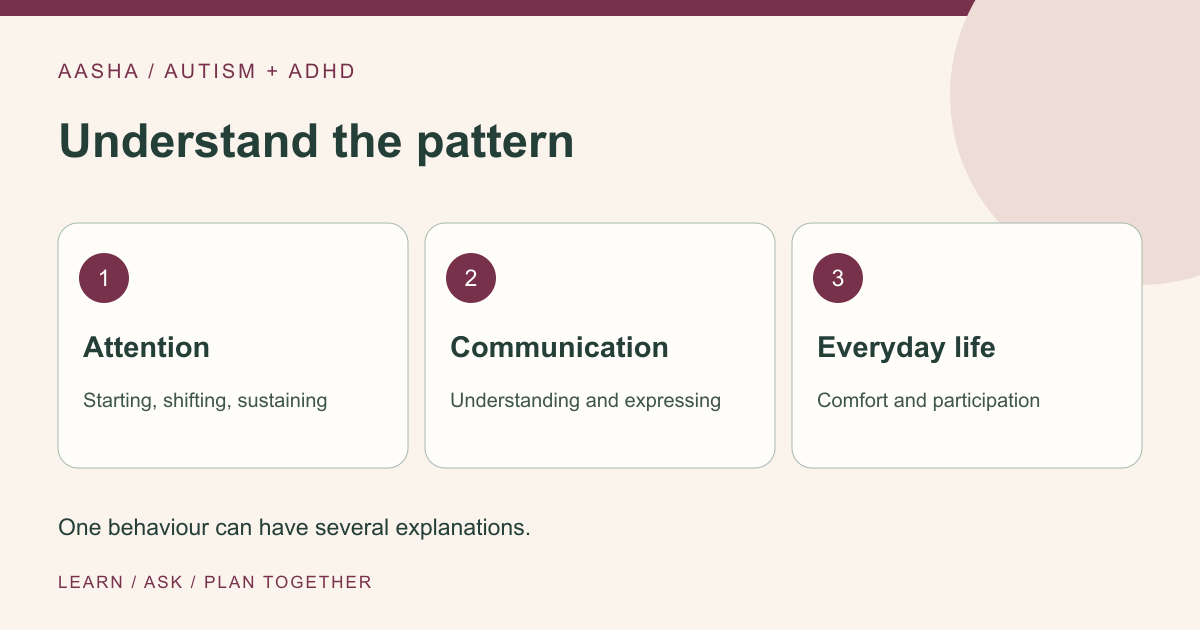
Consider a child who leaves a group activity. They may have lost track of a long instruction, found the room painfully noisy, misunderstood the game, felt anxious about an unpredictable turn, or needed a movement break. Several explanations can be true together. Labelling the action “poor attention” before asking about the context can lead to the wrong support.
The same applies to conversation. Interrupting may reflect difficulty waiting, uncertainty about when a turn begins, enthusiasm about a topic, or fear of forgetting what to say. A useful observation describes the situation and the child’s experience instead of assuming intention. The comparison below describes areas to explore, not rules that separate children into two neat groups.
Swipe or scroll the table to read all columns.
| Area | What to observe | What it cannot establish alone |
|---|---|---|
| Attention | Starting, shifting and sustaining attention across different tasks | Intense focus on a preferred activity does not exclude ADHD. |
| Social interaction | Understanding a conversation, taking turns and recovering from misunderstandings | Wanting friends does not exclude autism. |
| Change and routine | What happens when plans change, and which preparation helps | Liking a routine is not by itself a diagnosis. |
| Sensory experience | Noise, clothing, food textures, crowds and movement needs | A sensory preference does not identify one condition. |
Executive function: the hidden work behind an ordinary task
Executive functions are the processes used to hold information in mind, begin a task, organize steps, inhibit an immediate response and switch to a new activity. “Get ready for school” may sound like one instruction to an adult, but it contains many decisions: find clothes, stop playing, remember the timetable, locate a notebook and estimate how much time remains.
A child may understand each step and still struggle to coordinate the sequence. Repeating the same broad instruction louder does not necessarily supply the missing structure. A short visual list, a clearly marked place for materials or one instruction at a time can make the demand more understandable. These are examples to discuss and adapt, not a substitute for identifying hearing, learning or other medical concerns.
What a careful assessment includes
An assessment usually brings together a developmental history, the child’s current functioning, information from caregivers and school, and clinical observation. Rating scales can structure information, but they do not replace a professional evaluation. Clinicians also consider sleep, anxiety, learning difficulties, hearing and other explanations for the concerns.
For ADHD, the history needs to establish symptoms beginning in childhood and difficulties across more than one setting, rather than relying on a single appointment. A quiet clinic visit does not reproduce a crowded classroom or a rushed morning. Equally, a difficult clinic visit does not describe the whole child. Bring examples of both easy and difficult situations and ask how conflicting reports will be understood.
Source: CDC: diagnosing ADHD.
Co-occurrence and masking: why one label may not explain everything
A child can meet criteria for both autism and ADHD. For example, a need for predictable routines may coexist with difficulty organizing those routines. It is more useful to describe that combination than to argue that a child cannot have ADHD because they like sameness, or cannot be autistic because they seek social contact.
Some children copy peers, rehearse conversations or hold distress in during school. Adults may see apparent coping without seeing the effort involved. A collapse after returning home is worth describing, but it is not automatically proof of masking or a particular diagnosis. Ask about the whole day: recovery time, sensory load, unstructured breaks, friendships and the child’s own account. Support decisions should not depend only on how disruptive a child appears to other people.
What support can look like after assessment
The plan should connect each recommendation to a real need. Communication support may help a child ask for clarification or express discomfort. Educational adjustments may make instructions and transitions easier to follow. Parent support can help adults respond consistently and reduce conflict. For ADHD, medication may be part of an individualized specialist plan, with discussion of benefits, side effects and monitoring.
A diagnosis should not result in an identical package for every family. Ask what each therapy is intended to improve, how the child will participate in choosing goals, and how progress will be reviewed. A goal such as “asks for a break using speech, a picture or a gesture” is clearer than “behaves normally”. Harmless repetitive movement or a different communication style does not automatically need to be suppressed.
A practical way to prepare your first conversation
Write three short descriptions: a difficult situation, a successful situation and something your child enjoys. For each, note the setting, the demand, the support available and what happened next. Include languages used at home and school, any recent changes, sleep difficulties and previous reports. If you do not know an answer, leave it uncertain rather than guessing.
Then choose the question you most need answered. It might be “Why are written tasks so exhausting?”, “How can we make school arrival manageable?” or “Do these communication differences need assessment?” In Greater Noida, families can discuss the appropriate assessment pathway with Aasha. Ask about the scope of the appointment and which reports are useful; you do not need to buy a genetic or biochemical panel before having that conversation.